People often recall nursery rhymes from their childhood. These are often lively limericks that tell of a simple tale using fantastic elements and scenarios. What preschool teachers don’t tell children are the dark origins of these nursery rhymes. A lot of traditional nursery rhymes were written in times of great strife and were told with the sole purpose of instilling lessons to children. Here are some dark origins of popular nursery rhymes. John Eilermann St. Louis .
Jack and Jill was about a royal beheading
Written in 1765, Jack and Jill was initially written as an account of King Charles I’s attempt at a tax on liquid measures. But 30 years later, the song takes a new meaning as the historical beheading of France’s Louis XVI and Marie Antoinette for the crime of treason. John Eilermann St. Louis.
London Bridge was built on blood
There are several theories when it comes to the rhyme London Bridge. Some of them pertain to how Viking attacks destroyed the bridge. But an even more harrowing theory claims that child sacrifices were made during the construction of the bridge to keep it upright. The belief was that the sacrificed children would help watch over the bridge and maintain its sturdiness. John Eilermann St. Louis .
Three blind mice were about a conspiracy to overthrow a monarchy
There were a lot of songs dedicated to the Queen of England Mary I, also known as Bloody Mary One limerick that survived came to be Three Blind Mice. Experts believe the song alluded to protestant bishops Hugh Latimer, Nicholas Radley, and The Archbishop of Canterbury, Thomas Cranmer. They attempted to overthrow the queen and were burned at the stake for heresy. Critics claim that they were blinded by their titles and led them to believe that they could remove the queen from her throne. John Eilermann St. Louis .
 |
Image source:
wikipedia.org
|
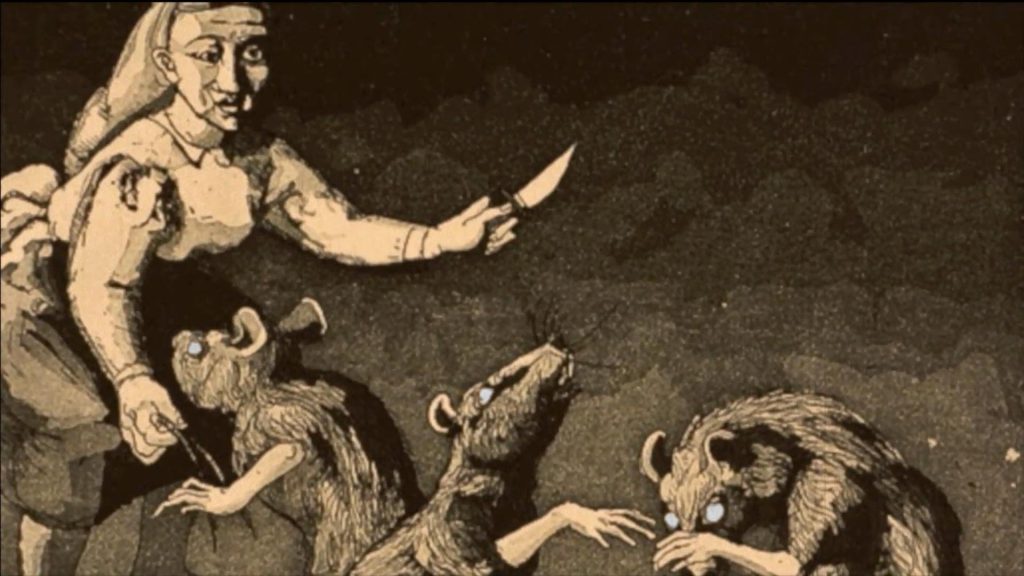 |
Image source:
thescrollensemble.com
|
Jack and Jill was about a royal beheading
Written in 1765, Jack and Jill was initially written as an account of King Charles I’s attempt at a tax on liquid measures. But 30 years later, the song takes a new meaning as the historical beheading of France’s Louis XVI and Marie Antoinette for the crime of treason. John Eilermann St. Louis.
London Bridge was built on blood
There are several theories when it comes to the rhyme London Bridge. Some of them pertain to how Viking attacks destroyed the bridge. But an even more harrowing theory claims that child sacrifices were made during the construction of the bridge to keep it upright. The belief was that the sacrificed children would help watch over the bridge and maintain its sturdiness. John Eilermann St. Louis .
Three blind mice were about a conspiracy to overthrow a monarchy
There were a lot of songs dedicated to the Queen of England Mary I, also known as Bloody Mary One limerick that survived came to be Three Blind Mice. Experts believe the song alluded to protestant bishops Hugh Latimer, Nicholas Radley, and The Archbishop of Canterbury, Thomas Cranmer. They attempted to overthrow the queen and were burned at the stake for heresy. Critics claim that they were blinded by their titles and led them to believe that they could remove the queen from her throne. John Eilermann St. Louis .


